
Spartaco Santi to Speak at Erice Biophysics 2026
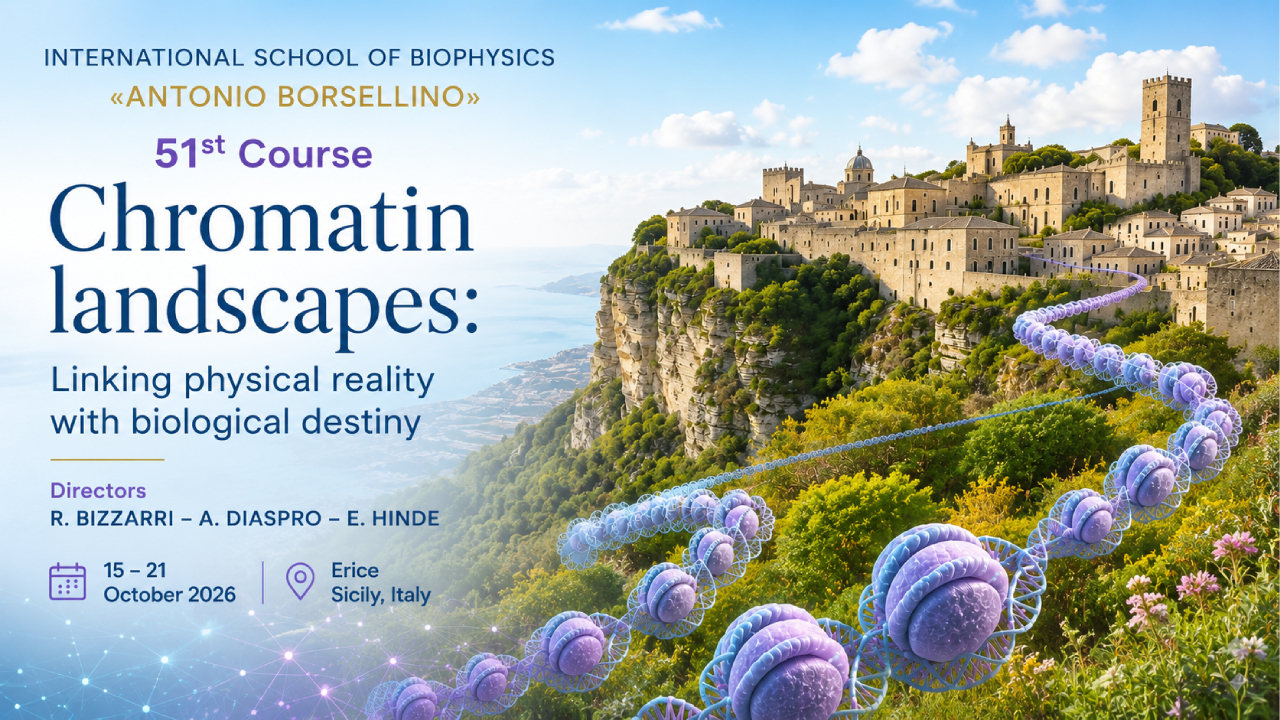
Spartaco Santi, Senior Researcher at the Institute of Molecular Genetics “Luigi Luca Cavalli-Sforza” of the National Research Council (CNR) in Bologna, will be an invited lecturer at the 51st Course of the International School of Biophysics “Antonio Borsellino”, held in Erice from 15 to 21 October 2026.
This year’s edition of the prestigious international gathering is centered around the theme “Chromatin Landscapes: Linking Physical Reality with Biological Destiny”.
«It promises to be a vital forum for scientific exchange», says Santi, previewing his upcoming lecture titled “The Journey of DNA Beyond the Genome.”
About the International School of Biophysics “Antonio Borsellino”
Reaching its 51st edition, the Erice course continues to serve as a premier global benchmark for exploring the intersection of biophysics, nuclear architecture, and computational modeling. Directed by Ranieri Bizzarri, Alberto Diaspro, and Elizabeth Hinde, the 2026 program brings together world-renowned scientists and is jointly organized by the Italian Society for Pure and Applied Biophysics (SIBPA) and the European Biophysical Societies’ Association (EBSA).
The School is named in honor of Antonio Borsellino, a pioneering figure in Italian physics and biophysics who was instrumental in founding the center in 1970 and served as its first director.
The event will take place at the Ettore Majorana Foundation and Centre for Scientific Culture, the institution founded by Antonino Zichichi to foster international scientific collaboration.
Registration and Application Deadline
The course is tailored primarily for early-career researchers, PhD students, and postdocs. The deadline for submitting applications is 5 October 2026. Complete registration guidelines, application details, and event information can be found directly on the official registration page.
Partner Support
«I would like to extend my sincere thanks to Fondazione Golinelli for partnering with this initiative and for supporting an event of such high scientific standing», concludes Spartaco Santi.
